Stampin' Up!
2025–2026
Turning a 15–20 hour publishing process into a sub-1-hour production system
A recurring product publication that evolved from a manually built flyer into an automated, multi-market production system.

01 — THE PROBLEM
The team needed a complete product list. Excel was the starting point.
Online Exclusives began as a simple flyer featuring only a selection of products. Demonstrators wanted a complete, printable reference they could keep on hand and share with customers, so the initial direction was to build the expanded product list in Excel.
The spreadsheet solved the completeness problem, but not the usability problem. Product relationships—especially suites, bundles, and individual items—were difficult to understand, and many demonstrators preferred printed materials over working from spreadsheets.
From the beginning, I advocated for moving the publication into InDesign, where we could design around how the information was actually being used.

The Excel version brought the complete product offering into one place, but product relationships were difficult to see and maintaining each release was still heavily manual.
02 — THE EVOLUTION
Moving to InDesign solved the design problem. Not the production problem.
Moving the publication into InDesign meant we could finally design around the information—making suites, bundles, individual products, and pricing easier to understand.
Data Merge automated the predictable parts of the layout, but much of the Suites and Bundles sections still required manual entry and layout. Each release involved hours of copying, pasting, and rebuilding content across multiple markets.
The publication was better. The process behind it still wasn’t.

Data Merge worked well for predictable, repeating layouts, but the more complex Suites and Bundles pages still required a lot of manual production.
03 — THE SYSTEM
Data Merge could repeat a layout. I needed the system to understand it.
Once the InDesign version was established, I could see exactly where the manual work was happening. I built a set of InDesign scripts around the actual structure of the publication—handling document creation, product organization, image placement, market-specific formatting, and other repetitive production tasks.
The goal wasn’t to remove people from the process. It was to automate the predictable parts so our time could go toward the things that actually needed human judgment.

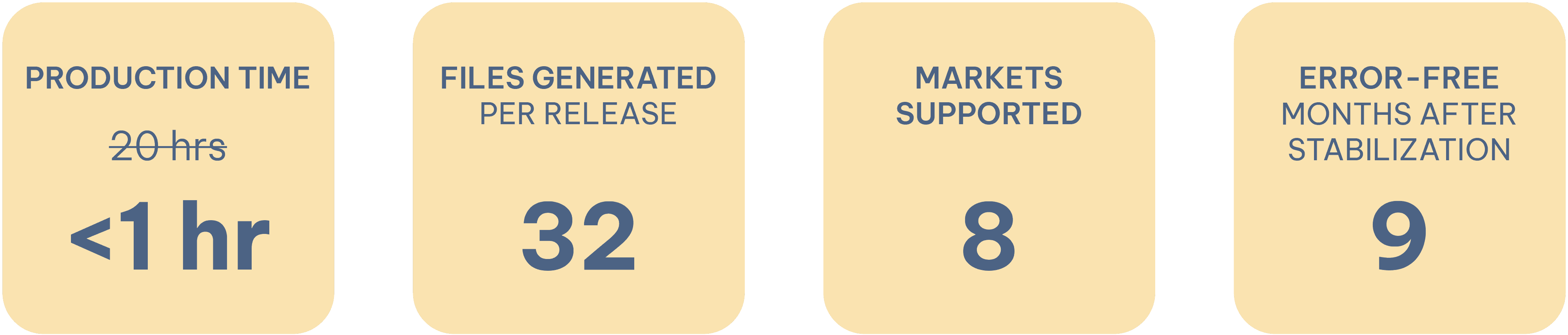
The finished system handled the repetitive production work across eight markets, while leaving final review and quality control in human hands.
04 — DESIGNING FOR EIGHT MARKETS
One system, eight different versions.
Each release was produced across eight markets, with differences in language, pricing, currency, product information, and formatting.
Rather than maintaining separate workflows for each market, I built those differences into the automation. The selected market determined which translations, pricing structures, formatting, and product rules the scripts applied.
One production system, with the differences handled automatically.

The layout stayed consistent, while the automation handled the language, pricing, formatting, and product rules unique to each market.
05 — QA + HUMAN REVIEW
Automation handled the repetition. People handled the judgment.
The system automatically flagged common production issues like missing images, overset text, and broken links. I still reviewed the details that required human judgment, including pricing, product relationships, international formatting, and overall layout.
Reviews happened through InDesign’s Share for Review, keeping feedback attached to the publication throughout revisions.
Automation made the process faster without removing the checkpoints that kept it accurate.
06 — THE RESULTS
From 15–20 hours to under one.
What started as a heavily manual publishing process became a repeatable system that was faster to produce, easier to review, and far less dependent on manual data entry.